v1.14· about/with Krishna
An entire army just made maximum noise. Krishna and Arjun picked up two Shankhas. Guess who won.
From a single white-horse chariot, Madhav and Arjun raised their divine Shankhas. Two voices answered a whole army — and the whole field went quiet.
“Two Shankhas answered an entire army. Divinity doesn't need volume — it needs truth.”
— Krishna
v1.15· about/with Bheem
Two Shankhas became three. And they all had names.
Hrishikesh blew Panchajanya. Dhananjay blew Devdatt. Bheem — the wolf-bellied, the mighty-armed — blew the great Paundra. Every conch had a name. Every name had a story.
“A weapon with a name is no longer a weapon. It is a story — a vow — a promise kept.”
— Krishna
v1.20
The greatest archer alive raised his bow. Then he saw who he was aiming at.
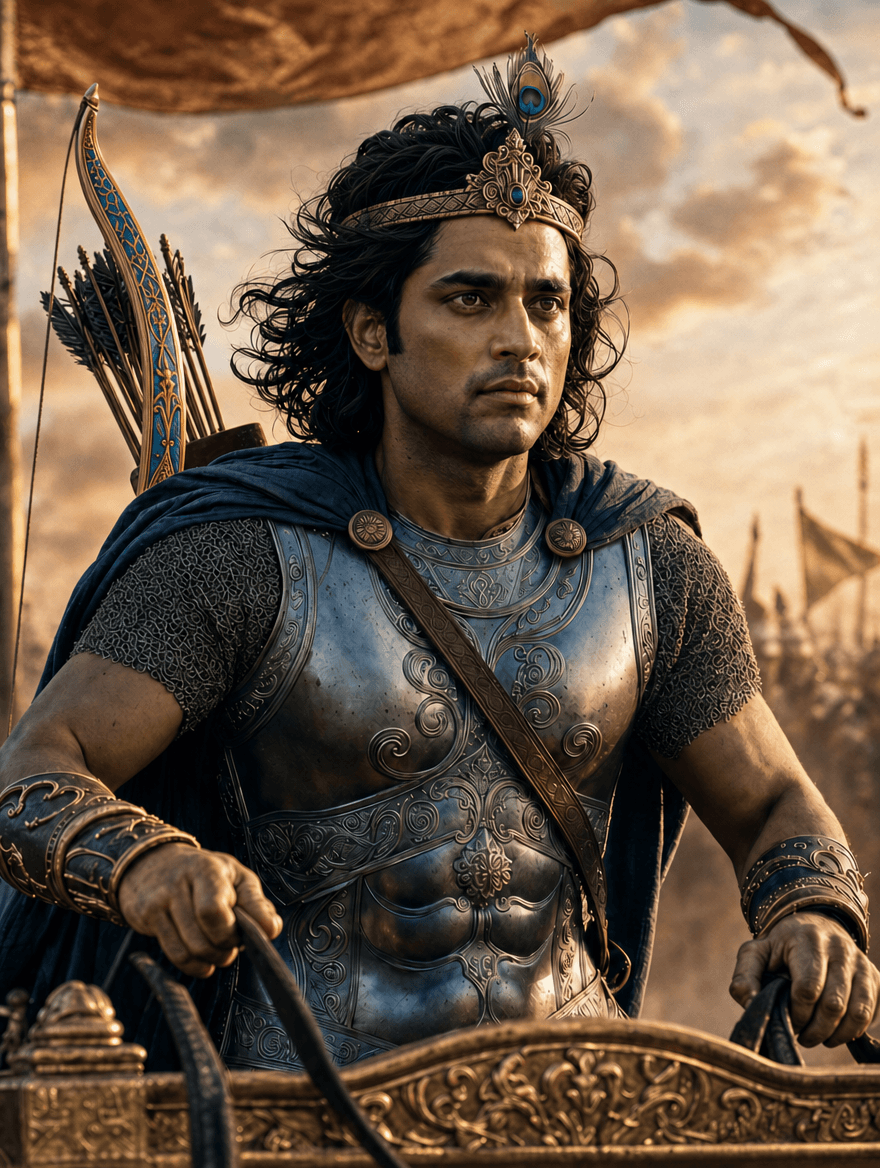
Then Arjun — the man with Hanuman on his flag — saw Dhritarashtra's sons arrayed before him. He raised his bow. And what he saw next changed everything.
“The bow was ready. The archer wasn't.”
— Krishna
v1.21
Arjun's first words in the Gita were a command to God. What did he ask Krishna to do?
Then Arjun spoke — his first words in the Gita. He said to Krishna: O Achyut, place my chariot between the two armies.
“He asked to see. He wasn't ready for what he'd find.”
— Krishna
v1.22
Arjun asked to see the enemy. He didn't know he was looking at his own family.
Let me see them — these men who stand here eager for war. With whom must I fight? He still thought it was a question about strategy.
“Sometimes the hardest battle is realizing who you're fighting.”
— Krishna
v1.23
Arjun called Duryodhan 'evil-minded.' Then he saw who was fighting for him.
Let me see them — those who assembled here to please the evil-minded Duryodhan. Show me who chose his side. He had no idea what he was about to see.
“It's easy to call the other side evil — until you see your own family standing there.”
— Krishna
v1.24· about/with Krishna
What happens when God does exactly what you ask Him to?
Arjun asked. Krishna obeyed. The master of the senses drove the chariot to the exact center of both armies — and what Arjun saw from there changed everything.
“Be careful what you ask for. The universe is listening.”
— Krishna
v1.25· about/with Krishna
Krishna spoke only once in Chapter 1. He pointed at the enemy. What did he say?
Krishna parked the chariot directly in front of Bhishma and Drona. Then he spoke — his only words in the entire chapter. O Parth — behold these Kauravs.
“Sometimes the cruelest thing you can do is show someone exactly what they asked to see.”
— Krishna
v1.27
Every face on the battlefield was someone he loved. What do you do when the enemy is family?
Fathers-in-law. Well-wishers. On both sides. All of them — kinsmen. Arjun saw every face and compassion broke through him like a flood. He sank into grief. And spoke.
“Compassion and duty walked onto the same battlefield. Only one of them could stay standing.”
— Krishna
v1.28
He called them "evil." Five verses later he called them "my own people." What changed?
Five verses ago he called them evil. Now he calls them my own people. His limbs are sinking. His mouth is drying up. The warrior's body is betraying him.
“The body knows before the mind does. Listen when it speaks.”
— Krishna
v1.29
The greatest archer alive couldn't hold his own bow. What made him drop it?
His body is trembling. His hair is standing on end. And Gandiva — the divine bow that never left his hand — is slipping from his grip.
“The weapon doesn't fall from the hand. It falls from the heart.”
— Krishna
v1.30
First his body failed. Then his mind. What does the greatest warrior see now?
First the body broke. Now the mind. Arjun cannot stand. His thoughts are spinning. And everywhere he looks, he sees only omens of destruction.
“When the mind stops seeing strategy and starts seeing consequences — that's when the real question begins.”
— Krishna
v1.31
A warrior said he didn't want victory. What could make a man renounce everything he trained for?
I see no good in killing my own people. I don't want victory. I don't want the kingdom. I don't want the happiness that comes with it.
“What you're willing to give up tells you more than what you're willing to fight for.”
— Krishna
v1.32
What's the point of winning if everyone you'd celebrate with is dead?
Yesterday he didn't want victory. Today he doesn't want to be alive. What use is a kingdom, O Govind, when the people who'd share it are the ones you have to kill?
“A kingdom means nothing if the people you built it for are gone.”
— Krishna
v1.33
He fought for them. They're the ones he has to kill. What do you do with that?
The people he'd share the kingdom with. The people he fought for. They're standing right here — on this field — ready to die. They ARE the war.
“The prize and the cost were the same people.”
— Krishna
v1.34
He'd rather die than fight. What makes the greatest warrior alive choose death?
Teachers. Fathers. Sons. Grandfathers. Every one of them — family. And Arjun says: even if they kill me first, I will not kill them.
“Choosing not to fight is also a choice. The question is what you're choosing it for.”
— Krishna
v1.35
Give him heaven, earth, and everything below. He still wouldn't fight. Why?
Not for this kingdom. Not for this earth. Not even for the sovereignty of all three worlds. There is no prize large enough to justify killing your own family.
“No prize is large enough when the cost is the people you'd share it with.”
— Krishna
v1.36
He knew they were guilty. The law said kill them. He still said no. Why?
Yes, they are aggressors. Yes, the law says kill them. But O Madhav — they are my family. And sin will cling to us no matter what the law allows.
“Knowing someone is guilty doesn't make killing them feel like justice. Not when they're family.”
— Krishna
v1.37
They were blinded by greed. But Arjun could see. Was seeing clearly a gift — or a curse?
Greed has blinded them. They cannot see the sin in destroying their own family. They cannot see the crime in betraying their own friends.
“Seeing the sin doesn't free you from it. It just makes the choice harder.”
— Krishna
v1.38
If you can see the sin and they can't — should you stop them, or join them?
They're blinded by greed. We are not. We can see the sin clearly. So why shouldn't we — who see it — be the ones to walk away?
“Clarity without action isn't wisdom. It's a comfortable excuse.”
— Krishna
v1.39
Kill a family and you don't just end lives. You end a thousand years of dharma.
When a family falls, its ancient dharma dies with it. And where dharma dies, adharma doesn't just arrive. It overwhelms. It takes everything.
“Dharma doesn't die in one battle. It dies when the people who carry it disappear.”
— Krishna
v1.40
Arjun predicted what happens when a civilization's structure collapses. Was he right?
When adharma rises, the structure collapses. The women who carried the lineage are left unprotected. And the social order that held everything together begins to unravel from the inside.
“Order doesn't collapse from the outside. It collapses when the people holding it are gone.”
— Krishna
v1.41
Kill a family and the dead suffer too. How far back does the destruction reach?
The destruction doesn't stop with the living. When the family falls, the ancestors fall with them. No one left to perform the rituals. No one left to remember.
“The dead don't die alone. They die again when no one is left to remember them.”
— Krishna
v1.42
What took a thousand years to build can be destroyed in one afternoon. Who pays?
Eternal traditions. Timeless customs. Wiped out by one generation's war. What took a thousand years to build can be destroyed in a single afternoon.
“What's eternal isn't immune. It's just what hurts the most to lose.”
— Krishna
v1.43
He quoted scripture to justify giving up. Can the same book justify both action and inaction?
This isn't his opinion. It's what the scriptures say. Men who destroy their family's dharma dwell in hell — not for a season, but forever.
“Scripture doesn't take sides. It takes understanding.”
— Krishna
v1.44
He called them greedy. Then he realized — he was no different. What now?
Alas. What have we become? Driven by greed for a kingdom and its pleasures — we came here to kill our own people. We are the sin we accused them of.
“The hardest enemy to see is the one in the mirror.”
— Krishna
v1.45
The greatest warrior alive offered himself for slaughter. His last words before silence.
Let them come. Armed. Ready. Let them kill me standing here with empty hands and no will to fight. That would be better than this.
“Surrender without understanding isn't peace. It's collapse dressed as wisdom.”
— Krishna
[ FAQ ]
- Who is Arjun in the Bhagavad Gita?
- Arjun — The Warrior Who Froze. Chapter 1 is named after him — Arjun Vishad Yoga, the yoga of Arjun's despair. The bow-master who has never missed is about to drop his bow. His question is the question the entire Gita was written to answer.
- Which verses feature Arjun?
- Arjun appears in 27 verses in the Bhagavad Gita's Chapter 1: verse 1.14, verse 1.15, verse 1.20, verse 1.21, verse 1.22, verse 1.23, verse 1.24, verse 1.25 and 19 more.
- What does Arjun say or do in the Gita?
- In their first appearance, Arjun drives the moment: "An entire army just made maximum noise. Krishna and Arjun picked up two Shankhas. Guess who won.". Their full arc unfolds across every verse where their voice or action shapes the dialogue.